
This is one of my favorite questions to answer. Not just because I love talking about pizza, which I absolutely do, but because the answer tells you a lot about Italian food and the person asking.
When someone sits down at MaMeMi and genuinely does not know what to order, I do not just point at the menu. I ask them a few questions. What do you like? Do you want something safe or something surprising? Do you want meat or no meat? Do you trust me?
If the answer to that last question is yes, the evening always goes well.
But for those of you planning ahead, doing research, or reading this from your phone on the way to an Italian restaurant, let me give you the guide I would give any friend visiting Italy or sitting down at our table in Vesterbro for the first time.
These are the Italian pizza classics. What they are, who they are for, and when to order them.
Pizza Marinara
Toppings: Tomato sauce, garlic, oregano, olive oil. No cheese. Who it is for: The purist. The person who wants to taste the dough.
This is the oldest pizza still on menus today. It predates Margherita by over a century, going back to the sailors and working class of 18th century Naples who needed something cheap, filling, and made with ingredients that did not go off quickly. No cheese. No fuss. Just tomato, garlic, oregano, and olive oil. If you want to dig deeper into the history, our blog on where pizza comes from tells the full story.
If you want to understand what pizza actually is at its core, order a Marinara. Everything else is a variation on this foundation.
It is also 100 percent vegan, which is worth knowing. Not as an afterthought, but as an authentic Italian tradition. If you eat plant-based, we also have a dedicated vegan pizza selection in Copenhagen.
The garlic is the key. When it is done properly, baked just long enough to become sweet and golden rather than bitter and raw, it transforms the tomato sauce into something you will think about for days.
At MaMeMi: Our Marinara is the purest expression of our Roman-style dough. Thin, crispy, no cheese competing for your attention. If you want to taste what our dough is really about, this is the one to order.
Pizza Margherita
Toppings: Tomato sauce, fior di latte or buffalo mozzarella, fresh basil, olive oil. Who it is for: Everyone. Literally everyone.
I know it sounds boring. I know everyone thinks they have had Margherita before. But a properly made Margherita on great dough with quality mozzarella and fresh basil is not boring. It is a revelation.
This is the pizza that serious pizza makers use to judge each other. When the 50 Top Pizza guide, which is the most respected pizza ranking in the world, evaluates a pizzeria, the first thing they look at is the Margherita. Because if you cannot get this right, nothing else matters. It is why we treat it as our benchmark for the best pizza in Copenhagen.
The quality of mozzarella makes an enormous difference. Buffalo mozzarella is richer and more tangy than cow’s milk fior di latte. Both have their place. Ask which one is available and choose based on your mood. Neither is wrong.
The basil goes on after baking. If your basil arrives at the table brown and wilted, someone made a mistake.
At MaMeMi: Our Margherita is where you taste everything we do. The 48-hour fermented dough. The quality of our traditional Italian ingredients. The way our Roman-style base crisps evenly from edge to center. This is our benchmark and we take it seriously.
Pizza Amatriciana
Toppings: Tomato sauce, guanciale, Pecorino Romano, black pepper. Who it is for: The person who wants to understand Roman food.
Amatriciana comes from the small town of Amatrice in Lazio, just outside of Rome, and it is one of the four great Roman sauces alongside Carbonara, Cacio e Pepe, and Gricia. It started as a pasta dish and was so good that someone eventually put it on a pizza.
The combination of guanciale fat, sharp Pecorino Romano, and sweet-sour tomato is one of those flavor combinations that feels inevitable. Like these three things were always meant to be together. Which, in central Italian cooking, they essentially were.
You can read all about guanciale and Pecorino Romano in our blog about traditional Italian pizza toppings you should try. The short version is that guanciale renders differently from any other cured pork and Pecorino Romano has a sharpness that you cannot get from Parmesan. Together they create something greater than the sum of their parts.
At MaMeMi: Amatriciana is one of our most loved pizzas. The guanciale fat enriches the tomato sauce during baking and the Pecorino Romano develops these beautiful golden spots on top. It is a pizza that rewards attention.
Pizza Cacio e Pepe
Toppings: Pecorino Romano, black pepper. No tomato. No mozzarella. Who it is for: The cheese lover who is not afraid of simplicity.
This one raises eyebrows every time. Just cheese and pepper? On pizza? Yes. And it is extraordinary.
Cacio e Pepe is another of the four great Roman sauces, and arguably the most demanding. The name means cheese and pepper in Roman dialect. Cacio refers to Pecorino Romano. The whole point of this dish is to take two ingredients and make them into something that feels much more complex than two ingredients should be able to produce.
On pizza, this means a generous layer of Pecorino Romano, freshly cracked black pepper in quantities that might alarm you but will not when you taste the result, and a thin, crispy Roman base that can carry the intensity without being overwhelmed. If you want to understand the technique behind that base, our blog on how pizza is cooked in Italy walks through the traditional methods.
The pepper is not decoration. It is half the dish. Good black pepper has floral, woody, aromatic qualities that disappear in pre-ground pepper. This pizza needs freshly cracked black pepper, and quite a lot of it.
If you trust us, order this. It will change how you think about what pizza needs.
At MaMeMi: Our pizza Cacio e Pepe is a direct tribute to Rome. It is the kind of thing that Italians order when they see it on a menu outside Italy and want to know if a restaurant really understands Roman cooking.
Pizza Quattro Formaggi
Toppings: Four cheeses, typically mozzarella, gorgonzola, fontina, Parmigiano Reggiano. No tomato. Who it is for: The cheese enthusiast. The person who cannot choose just one cheese.
This is a pizza bianca, which means white pizza, with no tomato sauce. The base is simply olive oil and the four cheeses, each one melting differently and contributing a different note to the final flavor.
The combination varies by region and by restaurant, but the principle is consistent. You want cheeses at different stages of intensity. Something fresh and milky like mozzarella. Something sharp and tangy. Something funky and bold like gorgonzola. Something nutty and aged like Parmigiano.
Together they create a richness and complexity that you simply cannot get from a single cheese. This kind of layered richness pairs beautifully with Italian wine — see our guide on which wine goes best with your pizza if you want to make the whole meal sing.
This is not a pizza to eat when you want something light. It is a pizza to eat when you want to feel taken care of. If it is your kind of thing, our Italian gourmet pizza selection has more in this direction.
At MaMeMi: When we make a four cheese pizza, we think carefully about which cheeses work together and with our Roman-style base. The crispiness of our crust is actually perfect for cheese-heavy pizzas because it provides structure and contrast.
Pizza Capricciosa
Toppings: Tomato, mozzarella, ham, mushrooms, artichokes, olives. Sometimes a hard boiled egg in certain regions. Who it is for: The person who cannot decide and wants a little of everything.
The name means capricious or whimsical, which is exactly what this pizza is. The toppings vary from region to region and sometimes from pizzeria to pizzeria. The philosophy is abundance rather than restraint.
This is the pizza you order when you want something generous and satisfying and do not feel like making decisions. When everything on the menu sounds good and you just want someone to pile the good stuff on and bring it to the table.
It is festive food, the kind of pizza you order at a birthday dinner when everyone is in a good mood and nobody is counting anything. If you want a warm start to that kind of meal, our antipasti guide walks you through how to open the table the Italian way.
At MaMeMi: We approach Capricciosa with the same care as our simpler pizzas. The toppings have to work together, not just coexist. Every ingredient earns its place.
Pizza Diavola
Toppings: Tomato, mozzarella, spicy salami, chilli oil. Who it is for: The heat lover. The person who does not understand the point of mild food.
Diavola means devil in Italian, which tells you everything you need to know about the heat level. This is a spicy pizza, built around the combination of sharp tomato sauce, milky mozzarella, and spicy Italian salami that releases its chilli oils during baking.
The heat in a good Diavola is not aggressive in the way that some spicy food is. It builds slowly through the pizza and sits alongside the other flavors rather than drowning them. You feel it but you are not distracted by it.
A drizzle of chilli oil over the top after baking adds a second layer of heat and a beautiful sheen.
This is one of the most popular pizzas in Italy for a very good reason. It is immediately satisfying in a way that is hard to explain until you experience it.
At MaMeMi: Heat is something we respect rather than show off. Our Diavola builds through the pizza rather than overwhelming it. The thin Roman base means the heat hits you differently than on a thicker pizza. Everything is more immediate and precise.
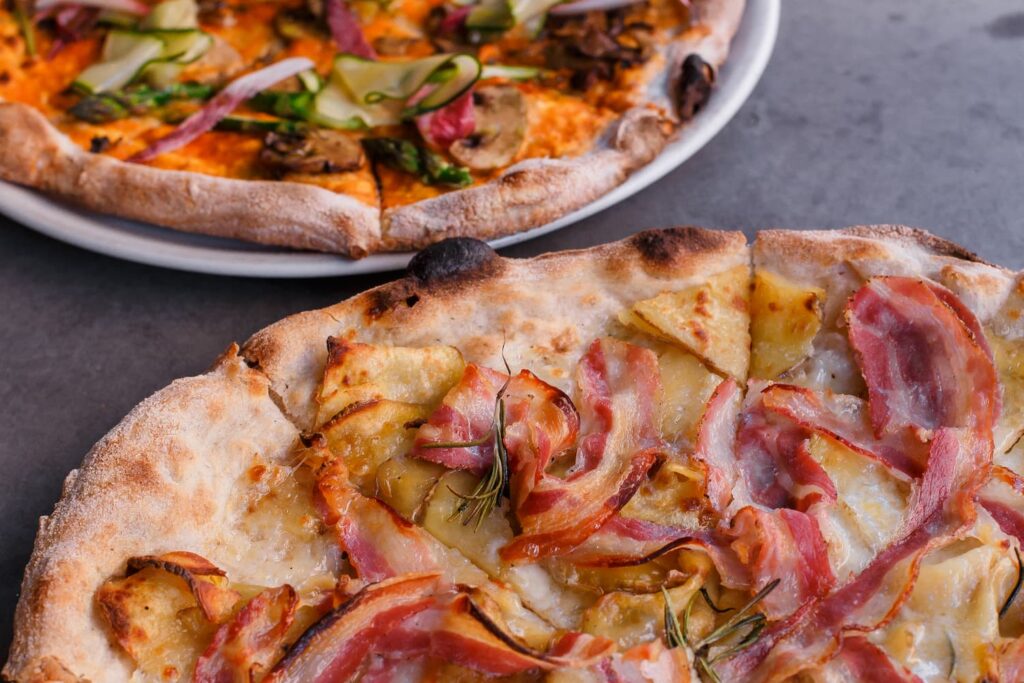
Pizza con Patate (Potato Pizza)
Toppings: Thinly sliced potato, rosemary, olive oil, sea salt. No tomato. No cheese. Who it is for: The person who wants to be surprised. The skeptic who becomes a convert.
I know what you are thinking. Potato on pizza?
Yes. And this is one of those dishes that sounds wrong until you try it and then you cannot imagine a world without it.
Pizza con Patate is a Roman tradition. You find it in bakeries and pizza al taglio shops all over Rome, sold by weight, eaten standing up. The potatoes are sliced paper thin, layered across the pizza dough, drizzled with very good olive oil, scattered with fresh rosemary and sea salt, and baked until golden and slightly crispy at the edges.
The result is incredibly satisfying. Starchy, earthy, herby, rich from the olive oil, crispy from the oven. Both the potato and the pizza dough become this beautiful unified thing.
It is also naturally vegan, which is a bonus for those who want it.
At MaMeMi: We put potato pizza on the menu because it is a genuine Roman tradition and because it surprises people in the best possible way. If you see it on our seasonal menu, order it. You will not regret it.
How to Choose
Now that you know the classics, here is my honest guide to choosing.
- Order Marinara if: You want to taste the dough and trust the ingredients.
- Order Margherita if: You want the classic. You want to taste quality without distraction. You are bringing someone to Italian pizza for the first time.
- Order Amatriciana if: You want Roman flavor at its most confident. You like guanciale, you appreciate Pecorino Romano, and you understand that great tomato sauce is not simple.
- Order Cacio e Pepe if: You love cheese. You love pepper. You trust us.
- Order Quattro Formaggi if: You are in a rich, indulgent mood and cheese is your love language.
- Order Capricciosa if: You want abundance. You are celebrating. You cannot decide.
- Order Diavola if: You like heat. You want something bold and immediately satisfying.
- Order Con Patate if: You want to be surprised. You want to eat something you have never thought of before. You trust that Rome has been putting potatoes on pizza for a very long time.
Or, and this is always my recommendation, just tell us what you are in the mood for. We will point you in the right direction — especially if you pair it with a glass from our Italian wine bar in Copenhagen, where our sommelier Danilo has curated over 1000 natural Italian wines.
One Last Thought
The 50 Top Pizza guide for 2025, which is the world’s most respected pizza ranking, put I Masanielli in Caserta at the very top. Every year this list reminds us that the best pizza in the world is still Italian, still built on the same principles of quality ingredients and proper technique, and still served in restaurants where people care deeply about what they put on the table.
At MaMeMi, we are not the biggest restaurant in Copenhagen. We are not trying to be. We are three cousins from near Rome who make the pizza we grew up eating and who take our work seriously.
If you come in not knowing what to order, just ask us. We love this conversation.
Book your table or walk in — see you soon.
Francesco
MaMeMi is located at Mysundegade 28, Vesterbro, Copenhagen. Authentic Roman-style pizza open Wednesday through Sunday for dinner, and Saturdays and Sundays from 12:00 for lunch. Over 1000 natural Italian wines curated by our sommelier Danilo. Book your table or walk in.